

Thursday, September 24
7:30 pm - 9:00 pm
Registration Required Below
Part I — The First Amendment: Freedom of Speech, Religion, Assembly and the Press
What does the First Amendment mean to a democratic republic — and what happens when the freedoms it protects come under pressure?
Join us for a conversation with Robert Post, one of the foremost First Amendment scholars in the world, for an illuminating exploration of the central role the First Amendment plays in American democracy.
The First Amendment protects some of our most fundamental freedoms: speech, religion, assembly, and the press. It is uniquely central to our nation’s purpose and its viability as a democratic republic, yet these freedoms are neither simple nor absolute. In a time of increasing authoritarianism, intense political division, changing technology, challenges to the press, and ongoing debates about the boundaries of free expression, understanding the principles behind the First Amendment has never been more important.
Post is the author of numerous books and articles on constitutional law and the First Amendment, including Citizens Divided: Campaign Finance Reform and the Constitution. He is a leading scholar whose work has helped shape the national conversation about freedom of speech, constitutional democracy, and the role of the courts.
Join us for a thoughtful and timely conversation about what the First Amendment means — and why it matters.
This virtual webinar will be hosted via Zoom. Registered participants will receive an invitation with a link prior to the program. Please include a cell phone number to receive a text reminder.
Save the Date:
Tuesday, November 17 at 7:30 pm — The Constitution and Our Rights Part II
The Second Amendment: Gun Rights and the American Debate with Mike McIntire, Pulitzer Prize-winning investigative journalist with The New York Times and author of Ricochet: Guns, Greed and the American Way of Violence. Click here for information or to register.
Panelists:
Robert Post is Sterling Professor of Law at Yale Law School and served as the school’s dean from 2009 to 2017. Before coming to Yale, he taug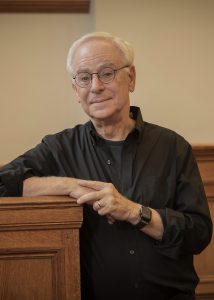 ht at the University of California at Berkeley School of Law.
Post specializes in constitutional law, with a particular emphasis on the First Amendment. He has written and edited numerous books, including The Taft Court: Making Law for a Divided Nation, 1921-1930 (2024), which is Volume 10 of the Oliver Wendell Holmes Devise History of the Supreme Court of the United States; Citizens Divided: A Constitutional Theory of Campaign Finance Reform (2014), which was originally delivered as the Tanner Lectures at Harvard in 2013; Democracy, Expertise, Academic Freedom: A First Amendment Jurisprudence for the Modern State (2012), which was originally delivered as the Rosenthal Lectures at Northwestern University; For the Common Good: Principles of American Academic Freedom (with Matthew M. Finkin, 2009), which has become a standard reference for the meaning of academic freedom in the United States; and Prejudicial Appearances: The Logic of American Antidiscrimination Law (2001), which was original delivered as the Brennan Lectures at Berkeley.
Post publishes regularly in legal journals and other publications; exemplary articles and chapters include “Data Privacy and Dignitary Privacy: Google Spain, The Right to be Forgotten, and the Construction of the Public Sphere” (Duke Law Journal, 2018); “The Politics of Religion: Democracy and the Conscience Wars,” in The Conscience Wars: Rethinking the Balance Between Religion, Identity, and Equality (Susanna Mancini and Michel Rosenfeld, eds., Cambridge University Press 2018); “Theorizing Disagreement: Reconceiving the Relationship Between Law and Politics” (California Law Review, 2010); “Roe Rage: Democratic Constitutionalism and Backlash” (with Reva Siegel, Harvard Civil-Rights Civil-Liberties Law Review, 2007); “Foreword: Fashioning the Legal Constitution: Culture, Courts, and Law” (Harvard Law Review, 2003); and “Subsidized Speech” (Yale Law Journal, 1996).
Post is a member of the American Law Institute and a fellow of both the American Philosophical Society and the American Academy of Arts and Sciences.

Dr. Daniel W. Barrett is a Professor Emeritus at the Department of Psychology at Western Connecticut State University. A former resident of Redding, he graduated with a BA from Wesleyan University, earned his Ph.D. in Social Psychology from Arizona State University and served as a Postdoctoral Research Fellow in Health Communication at the Annenberg School for Communication at the University of Pennsylvania. He is the editor of the forthcoming Social Influence: Key Debates and Contending Perspectives and the author of Social Psychology: Core Concepts and Emerging Trends as well as numerous publications.
Registration is currently closed for this event.